
MetLife Stadium: World Cup 2026 Final Venue
 Available in US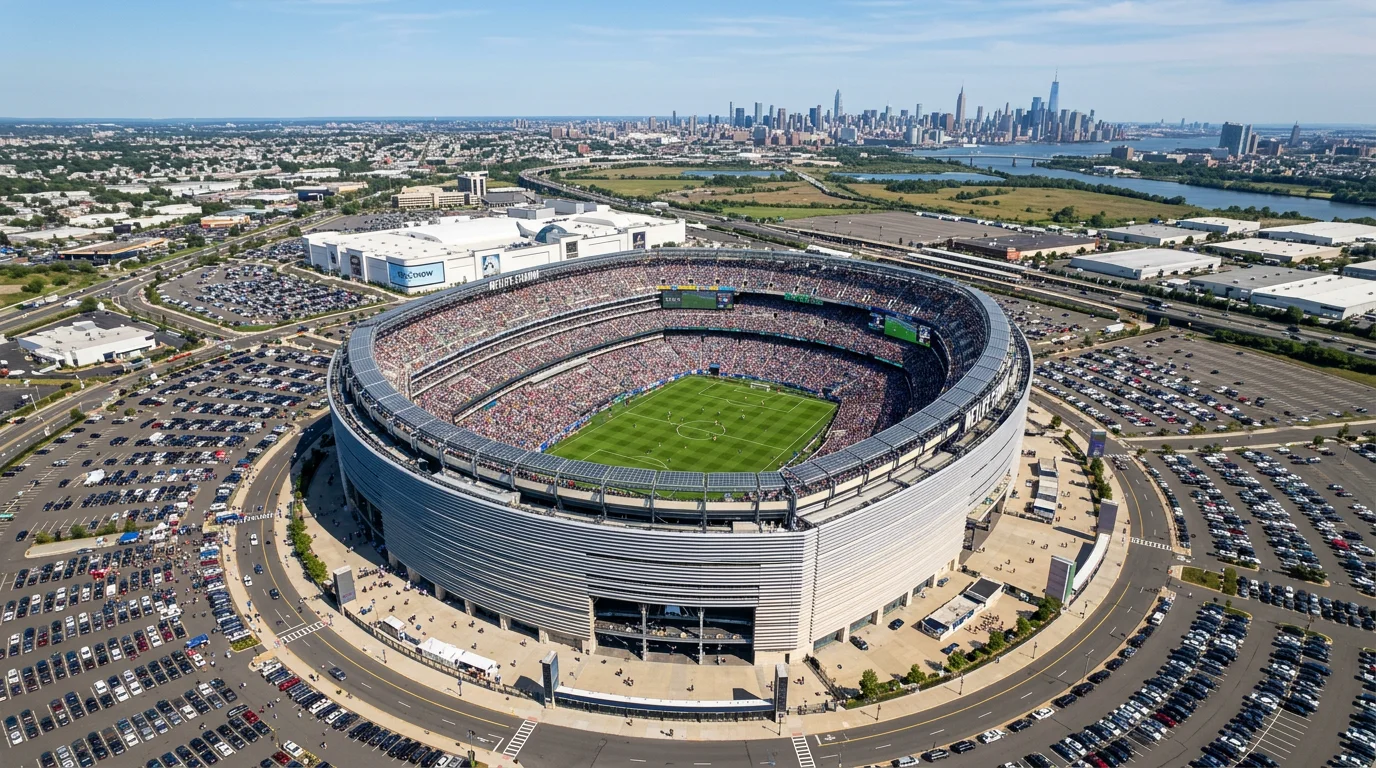
On 19 July 2026, two nations will walk onto the pitch at MetLife Stadium in East Rutherford, New Jersey, and one of them will lift the FIFA World Cup trophy. That stadium — a 82,500-seat colosseum tucked into the Meadowlands marshes just across the Hudson River from Manhattan — is the centrepiece of the entire tournament. It hosts both semi-finals, the final itself, and a clutch of group-stage and knockout matches that make it the single most important venue at this World Cup. For Irish supporters planning to travel, whether to watch a group match or simply to be part of the atmosphere around the final, MetLife represents the beating heart of a tournament spread across three countries and 16 stadiums. View all locations in our all 16 World Cup 2026 stadiums guide.
Stadium Profile: Capacity, Location and History
MetLife Stadium opened in 2010 as a replacement for the old Giants Stadium, which had stood on the same Meadowlands site since 1976. The construction cost approximately $1.6 billion, making it one of the most expensive stadiums ever built at the time, though that record has since been eclipsed by SoFi Stadium in Los Angeles and Tottenham Hotspur Stadium in London. The stadium serves as the home ground for both the New York Giants and New York Jets of the NFL, an unusual arrangement in American sports where two franchises share a single venue. That dual tenancy means the stadium was designed for maximum flexibility — the pitch dimensions can be configured for American football, football, concerts, and other large-scale events without structural modification.
The seating capacity for World Cup 2026 matches at MetLife is listed at approximately 82,500 in its standard football configuration, though FIFA may adjust this figure depending on the specific hospitality and broadcast requirements for the final and semi-finals. The stadium is an open-air venue — it has no retractable roof — which means weather conditions will play a role in matches. July in the New York metropolitan area is characteristically hot and humid, with average temperatures around 29-31 degrees Celsius and humidity levels that can make the air feel significantly warmer. For European teams accustomed to temperate summers, the heat and humidity at MetLife will be a factor worth considering in your pre-match analysis.
The pitch surface at MetLife has historically been a point of contention. The stadium uses an artificial turf system for its NFL tenants, but FIFA requires natural grass for World Cup matches. A temporary natural grass surface will be installed for the tournament — a process that involves laying turf over the existing artificial surface and maintaining it through the group stage and knockout rounds. FIFA have confirmed that all World Cup venues will use natural grass, and MetLife’s conversion is scheduled well in advance of the opening fixtures. The quality of temporary grass surfaces at American stadiums has improved dramatically since the issues that plagued the 2016 Copa America Centenario, where players complained about divots and uneven surfaces, so I do not expect pitch quality to be a significant concern in 2026.
World Cup 2026 Matches at MetLife Stadium
MetLife hosts more high-profile fixtures than any other venue at this tournament. The allocation includes group-stage matches, round-of-32 ties, round-of-16 ties, both semi-finals on 15 and 16 July, and the final on 19 July. The total number of matches at MetLife is among the highest of any venue, alongside AT&T Stadium in Dallas which hosts nine fixtures including a semi-final.
For bettors, the venue assignment matters because it affects team preparation and travel schedules. Teams drawn to play group-stage matches at MetLife will set up training bases in the New York metropolitan area, giving them familiarity with the conditions that could prove advantageous if they progress to the semi-finals or final at the same venue. This “home ground” effect within a neutral tournament is worth monitoring when assessing knockout-stage odds — a side that has already played at MetLife during the group stage will know the pitch, the dimensions, the sightlines, and the crowd dynamics in a way that an opponent arriving fresh from a venue in Dallas or Miami will not.
The semi-finals and final will kick off in the evening US Eastern Time — likely between 7pm and 9pm ET — which translates to midnight to 2am IST. These are late-night fixtures for Irish viewers, but the magnitude of the occasion makes the sleep deprivation a price worth paying. Pubs across Ireland will stay open for the final, and the atmosphere will echo the scenes from the 2022 World Cup final in Qatar, when Messi’s coronation kept Irish sports fans glued to screens into the small hours.
Getting There: Transport and Access
MetLife Stadium sits in the Meadowlands Sports Complex in East Rutherford, Bergen County, New Jersey — technically outside New York City but functionally part of the metropolitan area. The stadium is visible from midtown Manhattan on a clear day, and the journey from Times Square to the stadium gates takes approximately 30 to 45 minutes depending on traffic and transport mode.
NJ Transit operates a dedicated rail line to the Meadowlands station from Secaucus Junction, which connects to Penn Station in Manhattan. On event days, trains run at high frequency before and after matches, and this rail link is the most efficient way to reach the stadium from New York City. The journey from Penn Station to Meadowlands station takes roughly 20 minutes including the transfer at Secaucus, and the walk from the station to the stadium gates is short and well-signposted. For supporters staying in Jersey City, Hoboken, or Newark, NJ Transit bus services provide additional routes to the stadium complex.
Driving to MetLife is possible but inadvisable on match days. The stadium has over 28,000 parking spaces across multiple lots, but the approach roads — primarily the New Jersey Turnpike and Routes 3 and 120 — become gridlocked in the hours before kick-off. If you do drive, arrive at least three hours before the match to secure parking and allow time for the security screening process. Rideshare services operate designated pick-up and drop-off zones, though surge pricing around major events can make the cost eye-watering — budget $80-100 for an Uber from Manhattan to MetLife after a late kick-off.
East Rutherford and the New York Metropolitan Area
East Rutherford itself is a small borough of roughly 9,000 residents, and there is very little in the immediate vicinity of the stadium beyond the Meadowlands Sports Complex and the adjacent American Dream shopping and entertainment complex. The football happens in New Jersey; the nightlife, accommodation, and cultural attractions happen across the river in New York City.
For Irish supporters, New York is the most natural American city to visit. The Irish diaspora in the New York area is enormous — there are more people of Irish descent in the tri-state area than in many Irish counties — and the pubs, restaurants, and cultural institutions that cater to Irish visitors are well-established. Woodlawn in the Bronx, Sunnyside in Queens, and the remnants of Hell’s Kitchen in Manhattan all retain strong Irish identities, and World Cup match days will transform these neighbourhoods into open-air viewing parties. If you are travelling to MetLife for a match, I would recommend basing yourself in Manhattan or Jersey City, both of which offer straightforward transport links to the stadium and a far richer experience than staying in East Rutherford itself.
Accommodation prices in the New York area during the World Cup will be elevated, particularly around the semi-finals and the final. Booking well in advance is essential — hotels within a 30-minute radius of MetLife were already showing significant price increases for mid-July 2026 as of early 2026. Budget-conscious travellers should consider Airbnb options in Jersey City or Hoboken, both of which offer quick access to the stadium via NJ Transit and tend to be cheaper than Manhattan hotels by a factor of two or three.
Information for Irish Supporters Travelling
Ireland may not be at this World Cup, but that has never stopped Irish supporters from turning up at major tournaments. At Euro 2016 in France, the Irish contingent numbered in the tens of thousands and earned a reputation for good humour and spectacle that the host cities remember fondly. The same travelling culture will be on display in the New York area during July 2026, and there are a few practical considerations worth noting.
Irish passport holders can travel to the United States under the Visa Waiver Programme using ESTA, which must be applied for online at least 72 hours before departure. The ESTA authorisation costs $21 and is valid for two years, covering multiple entries of up to 90 days each. Direct flights from Dublin to New York’s JFK airport take approximately seven and a half hours, and several airlines operate daily routes. Shannon to Newark is another option, with slightly lower fares and a landing point that is closer to MetLife Stadium than JFK.
The currency is US dollars, and while credit and debit cards are accepted almost universally, having some cash for smaller purchases — street food vendors, subway tickets, tips — is advisable. Tipping culture in the United States is significantly more prominent than in Ireland: expect to tip 18-20% at restaurants, $1-2 per drink at bars, and $2-5 for taxi or rideshare services. The total cost of a week-long trip to New York for the World Cup final — including flights, accommodation, match tickets, food, and transport — will likely run between EUR 3,000 and EUR 6,000 per person depending on your accommodation choices and ticket category. Match tickets for the final will be the largest single expense, with FIFA’s general sale tickets starting at approximately $300 and hospitality packages reaching into the thousands. Track the final on KickOff26.
For those who cannot travel but want to follow the action, the World Cup 2026 betting guide covers every market available to Irish punters from the comfort of home.
Where is the 2026 World Cup final being played?
The 2026 World Cup final takes place at MetLife Stadium in East Rutherford, New Jersey, on 19 July 2026. The stadium also hosts both semi-finals and multiple group-stage and knockout fixtures, making it the most-used venue at the tournament.
How do I get to MetLife Stadium from Manhattan?
The most efficient route is by NJ Transit rail: take a train from Penn Station to Secaucus Junction, then transfer to the Meadowlands rail link. The total journey takes approximately 20-30 minutes. Driving is possible but traffic congestion on match days is severe, so public transport is strongly recommended.
