
Estadio Azteca: World Cup 2026 Opening Venue
 Available in US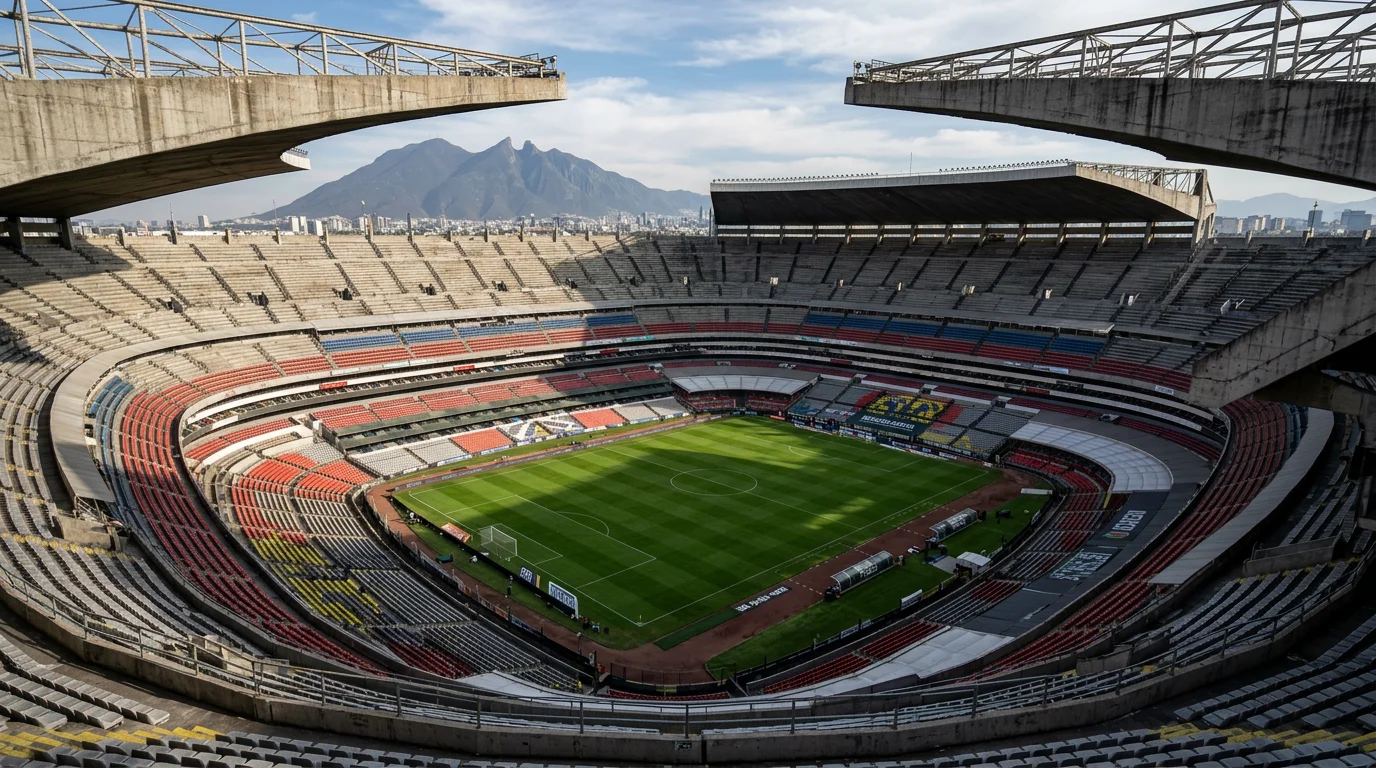
No stadium on earth has hosted two World Cup finals. Estadio Azteca has hosted both — Pele’s coronation in 1970 and Maradona’s “Hand of God” followed by the greatest individual goal ever scored in 1986. On 11 June 2026, when Mexico face South Africa in the tournament’s opening fixture, the Azteca will become the first and only stadium to host three World Cups, a distinction that no other ground can claim and that transforms this venue from a mere setting into a character in the story of football itself. I have been to the Azteca twice — once for a Liga MX final and once for a Mexico qualifier — and both times the atmosphere was something beyond loud. It was visceral, physical, a wall of sound that started before kick-off and did not relent until the final whistle.
Mexico City: Host City Profile
Before discussing the stadium, you need to understand the city it sits in, because Mexico City is unlike any other World Cup host city at this tournament. With a metropolitan population exceeding 21 million, it dwarfs every other venue city — New York included — in sheer human density. The sprawl extends in every direction from the historic centre, a grid of neighbourhoods that range from the colonial elegance of Coyoacan to the commercial intensity of Polanco to the working-class identity of Iztapalapa, where the Azteca stands.
Mexico City operates at an altitude of 2,240 metres above sea level, a fact that shapes every aspect of the football played within its borders. The air contains roughly 25% less oxygen than at sea level, and visiting players who have not acclimatised will feel the effects from the first sprint onwards — heavier legs, faster breathing, a recovery time between efforts that stretches from seconds to minutes. Teams based in the Mexican capital for Group A matches will need to arrive at least a week before their opening fixture to begin the acclimatisation process, and even then, the advantage goes to Mexico’s players who live and train at altitude year-round.
For Irish supporters considering a trip to the opening match, Mexico City is a destination that rewards exploration. The food alone — tacos al pastor from street vendors in Roma Norte, mole negro in Oaxacan restaurants in Condesa, fresh ceviche at the Mercado de San Juan — justifies the journey. The cultural infrastructure is extraordinary: the Museo Nacional de Antropologia, the Frida Kahlo museum in Coyoacan, the murals of Diego Rivera at the Palacio Nacional. And the cost of living is dramatically lower than in the US venues — a meal that would cost EUR 50 in Manhattan can be had for EUR 12 in Mexico City, making it the most budget-friendly World Cup experience available.
Transport within the city is a challenge. Traffic congestion is legendary — Mexico City consistently ranks among the most congested cities in the world — and the metro system, while extensive, becomes overwhelmingly crowded during events. Ride-hailing services like Uber and DiDi operate widely and are affordable by European standards, but journey times are unpredictable. On match days, I would recommend using the metro to the nearest station (Coyoacan on Line 3) and walking the remaining distance to the stadium, which takes approximately 20 minutes and avoids the worst of the traffic around the Azteca’s immediate vicinity.
A Three-Time World Cup Stadium: 1970, 1986, 2026
Estadio Azteca was inaugurated on 29 May 1966, built specifically to host the 1970 World Cup. The original design by architects Pedro Ramirez Vazquez and Rafael Mijares Alcereza created a stadium that held 107,000 spectators in a steep, enclosed bowl that channelled sound downward onto the pitch. That acoustic design was intentional — the architects studied European stadiums and concluded that the intensity of the atmosphere was directly correlated with the steepness of the stands and the proximity of spectators to the playing surface.
The 1970 World Cup is remembered as the most beautiful tournament ever played, and the Azteca was its cathedral. Brazil’s 4-1 victory over Italy in the final remains the benchmark for attacking football at a World Cup — Pele, Jairzinho, Tostao, Rivelino, and Carlos Alberto combining in a performance that transcended the sport. The final goal, scored by Carlos Alberto after a sweeping move involving nine of Brazil’s ten outfield players, was finished with a right-footed drive that entered the net before the goalkeeper could react. That goal was scored on Azteca turf, and the memory permeates the stadium to this day.
Sixteen years later, the Azteca hosted the 1986 World Cup final and the quarter-final between Argentina and England that produced the two most famous goals in the sport’s history. Maradona’s first goal — the “Hand of God,” a punch past Peter Shilton that the referee failed to spot — was followed four minutes later by a solo run from his own half that left five English players and the goalkeeper on the ground. Both goals were scored at the same end of the Azteca, in front of the same bank of supporters, within a four-minute span that defined an entire career. The stadium has been renovated several times since 1986, with the most recent modernisation reducing capacity to approximately 83,000 while improving sightlines, safety infrastructure, and accessibility.
For 2026, the Azteca has undergone further upgrades to meet FIFA’s current venue standards, including improvements to the press facilities, broadcast infrastructure, VIP areas, and pitch drainage system. The playing surface has been relaid with a hybrid grass system that combines natural turf with synthetic fibres to improve durability — a necessity given the altitude-related challenges of maintaining grass in Mexico City’s climate, which alternates between intense sun and heavy afternoon rainfall during the June rainy season. Explore all the venues in our all 16 World Cup 2026 stadiums guide.
World Cup 2026 Matches at Estadio Azteca
The Azteca hosts the tournament’s opening match — Mexico vs South Africa on 11 June 2026 — and a selection of Group A fixtures. The total allocation for the three Mexican venues is 13 matches, split between the Azteca, Estadio Akron in Guadalajara, and Estadio BBVA in Monterrey. The Azteca is likely to receive the most prestigious of these 13 fixtures, including at least one round-of-32 match and potentially a round-of-16 tie.
The opening match carries enormous symbolic weight. Mexico vs South Africa mirrors the 2010 World Cup opener in Johannesburg, where South Africa held Mexico to a 1-1 draw in a match that set the tone for a tournament defined by African pride and Latin American flair. Sixteen years later, the roles reverse — Mexico host, South Africa visit — and the Azteca will be packed with 83,000 supporters generating an atmosphere that few visiting teams can withstand.
For bettors, the altitude factor at the Azteca is worth quantifying. Historical data from CONCACAF World Cup qualifiers played in Mexico City shows that visiting teams score an average of 0.7 goals per match at altitude compared to 1.3 goals per match at sea-level venues — a difference of nearly half a goal per game. This suggests that under markets — particularly under 2.5 goals — offer value in Azteca fixtures involving non-acclimatised teams. The exception is Mexico’s own matches, where the crowd and the altitude combine to push home team scoring rates above the visiting team’s reduced output, resulting in matches that tend to produce 2-3 goals with a strong Mexico skew.
The Altitude Factor: 2,240 Metres Above Sea Level
I mentioned altitude in the Mexico City section, but it deserves dedicated analysis because this is the single most underpriced factor in the World Cup 2026 betting markets. At 2,240 metres, the Azteca sits higher than any other World Cup venue in history. The old Estadio Hernando Siles in La Paz, Bolivia, which hosted World Cup qualifiers at 3,637 metres, was eventually banned by FIFA for competitive matches above 2,500 metres — a ruling that was later relaxed — but the Azteca’s altitude is significant enough to affect performance without triggering regulatory concern.
The physiological effects are well-documented. At 2,240 metres, the barometric pressure is approximately 77% of sea-level values, which means each breath delivers less oxygen to the bloodstream. For athletes performing at high intensity, this translates to reduced VO2 max — the maximum rate at which the body can use oxygen during exercise — by roughly 6-8%. In practical terms, a midfielder who can sustain high-intensity pressing for 75 minutes at sea level may begin to fade after 55-60 minutes at the Azteca. Recovery between sprints takes longer, lactic acid accumulates faster, and the cognitive effects of mild hypoxia — slower decision-making, reduced peripheral awareness — compound as the match progresses.
The ball behaves differently at altitude too. With less air resistance, shots travel faster and swerve less predictably, making goalkeeping more difficult. Free kicks that would curl into the top corner at Wembley may sail over the crossbar at the Azteca, and goalkeepers accustomed to reading the flight of the ball at sea level need to adjust their positioning and timing. During the 1970 and 1986 tournaments, several goalkeepers spoke about the difficulty of judging long-range shots at the Azteca, and that challenge remains in 2026. Follow the tournament from the start page.
For bettors, the altitude factor should inform several market decisions. First, the under 2.5 goals market in matches involving two non-acclimatised sides is attractive because both teams will tire faster, reducing the tempo and the number of clear-cut chances. Second, late goals — after the 75th minute — are more likely to come from the team with superior fitness or altitude preparation, making the “goal in the last 15 minutes” market worth examining. Third, substitutions will play a more significant role than at sea-level venues, as fresh legs provide a disproportionate advantage in the final quarter of the match. Back the draw at half-time in early-round matches at the Azteca — the game often opens up in the second half as fatigued defences make errors they would not make at lower altitudes. A full rundown of all 16 venues is available in the World Cup 2026 betting guide.
Which matches are played at Estadio Azteca at the 2026 World Cup?
Estadio Azteca hosts the tournament opening match between Mexico and South Africa on 11 June 2026, along with additional Group A fixtures and potentially a round-of-32 or round-of-16 match. It is one of three Mexican venues alongside Estadio Akron in Guadalajara and Estadio BBVA in Monterrey.
How does altitude affect football at Estadio Azteca?
At 2,240 metres above sea level, the Azteca"s thin air reduces oxygen availability by roughly 25% compared to sea level. Players tire faster, recovery between sprints takes longer, and the ball travels faster with less swerve due to reduced air resistance. Non-acclimatised teams typically score fewer goals at altitude venues.
