
All 16 World Cup 2026 Stadiums
 Available in US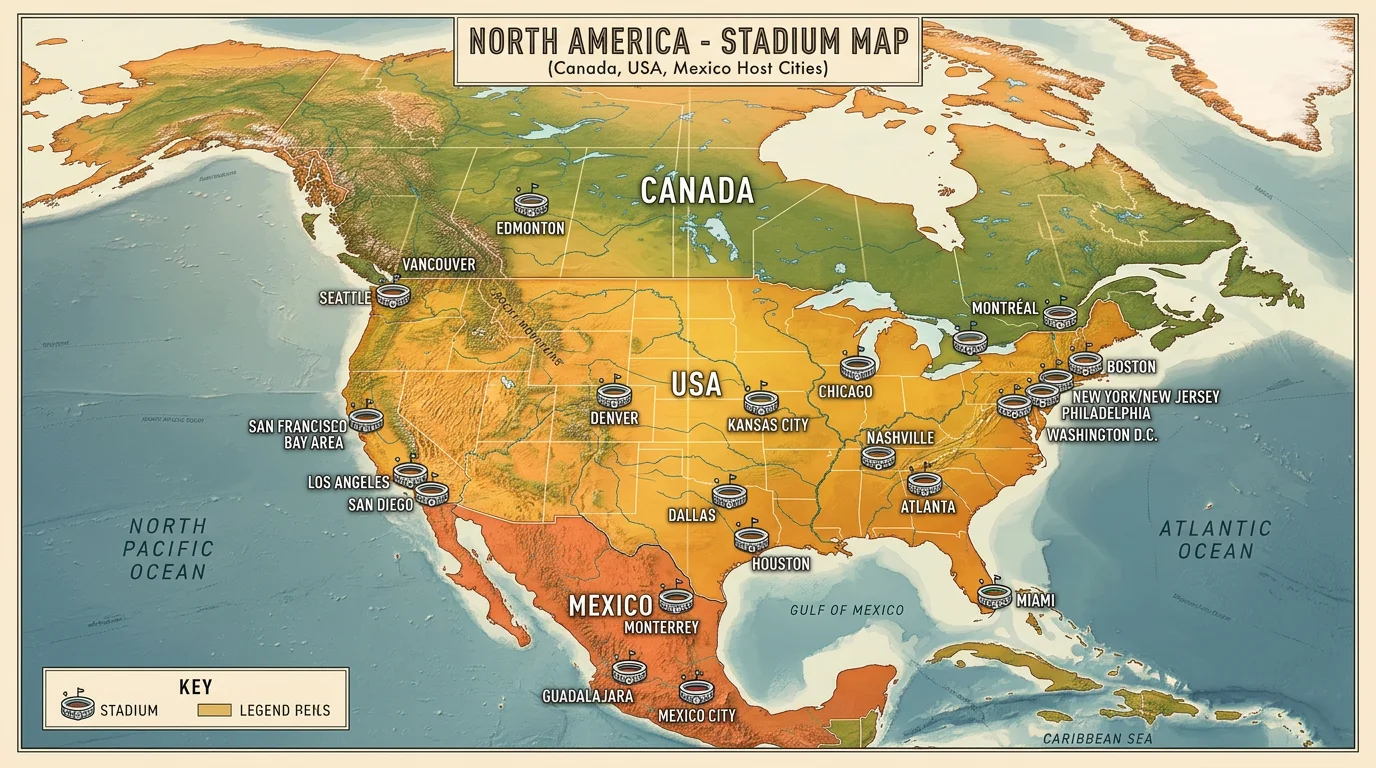
Sixteen stadiums across three countries, spanning four time zones and covering a north-south distance greater than Dublin to Cairo. The 2026 World Cup is the largest and most geographically dispersed tournament in FIFA history, and understanding the venues is not just a matter of trivia — it directly affects how you bet. Altitude in Mexico City, humidity in Houston, the artificial-to-natural grass conversions at NFL stadiums, the travel distances between group-stage venues: each of these factors influences match outcomes in ways that the odds do not always reflect. I have compiled this reference to give you a complete picture of every venue, organised by host country, with the details that matter for both supporters and punters.
United States: 11 Stadiums
The United States hosts 78 of the tournament’s 104 matches across 11 stadiums, and the variety of conditions across those venues is striking. From the Pacific Northwest rain of Seattle to the subtropical heat of Miami, from the thin air of Denver-adjacent venues to the controlled environments of domed stadiums, each American city brings its own climatic personality. Every one of these stadiums is primarily an NFL venue, which means each will undergo a conversion from American football configuration — including, in most cases, replacing artificial turf with temporary natural grass — in the weeks leading up to the tournament.
MetLife Stadium, East Rutherford, New Jersey — Capacity: 82,500. The crown jewel of the tournament: both semi-finals and the final on 19 July. Open-air venue in the New York metropolitan area. July temperatures average 29-31 degrees Celsius with high humidity. The temporary natural grass installation will be one of the most scrutinised in the tournament given the stakes of the matches played here. MetLife also hosts the highest number of total fixtures including group-stage and knockout matches.
SoFi Stadium, Inglewood, California — Capacity: 70,240. Home to the Los Angeles Rams and Chargers, SoFi is one of the newer venues on the roster, having opened in 2020. Its semi-enclosed design features a translucent ETFE roof that allows natural light while providing shade — a significant advantage during daytime kick-offs in the Southern California sun, where summer temperatures regularly exceed 30 degrees. The stadium hosted Super Bowl LVI in 2022 and the 2028 Olympic opening ceremony is also planned here, giving it a pedigree of major event hosting that few venues can match.
Hard Rock Stadium, Miami Gardens, Florida — Capacity: 64,767. The heat and humidity in South Florida during June and July are extreme — average temperatures of 32-33 degrees Celsius with humidity above 70%, creating a heat index that can feel like 40 degrees or higher. For European teams, this is the most physically demanding venue at the tournament. Hard Rock has a partial canopy that provides shade to some seating areas, but the pitch itself is fully exposed. Cooling breaks during matches played here are almost guaranteed under FIFA’s heat protocols.
AT&T Stadium, Arlington, Texas — Capacity: 80,000. The Dallas-Fort Worth venue hosts nine matches — the highest allocation of any stadium at the tournament — including a semi-final. AT&T Stadium features a retractable roof that will likely be closed during the tournament given Texas’s brutal summer heat, where outdoor temperatures in July average 36-38 degrees Celsius. The controlled indoor environment negates weather as a factor, making this a neutral venue in the truest sense. Jerry Jones’s $1.3 billion stadium is a monument to American sporting excess, and its sheer scale — the video board alone spans 49 metres — creates an atmosphere unlike any traditional football ground.
NRG Stadium, Houston, Texas — Capacity: 72,220. Another retractable-roof venue in Texas, NRG hosts group-stage and early knockout matches. Houston’s climate mirrors Miami’s for heat and humidity, and the roof will be closed to create a controlled environment. The stadium has experience hosting major football events, including multiple CONCACAF Gold Cup matches and the 2017 Super Bowl.
Mercedes-Benz Stadium, Atlanta, Georgia — Capacity: 71,000. Atlanta’s retractable-roof venue is one of the architectural standouts among the 16 stadiums, with a distinctive petal-shaped roof that opens and closes like a camera aperture. The enclosed environment removes weather as a variable, and the stadium’s reputation for generating noise — it regularly produces the loudest crowd readings in MLS for Atlanta United matches — will create an intense atmosphere for World Cup fixtures.
Lumen Field, Seattle, Washington — Capacity: 69,000. The Pacific Northwest offers the most temperate climate of any US venue, with July temperatures averaging 22-25 degrees Celsius and relatively low humidity. For European teams, Seattle’s conditions are the closest to home. Lumen Field is an open-air venue situated between the downtown waterfront and the industrial district south of Pioneer Square, and its location amplifies crowd noise in a way that has earned it the nickname “the 12th man” in NFL circles.
Levi’s Stadium, Santa Clara, California — Capacity: 68,500. Located in Silicon Valley, roughly 50 kilometres south of San Francisco, Levi’s Stadium hosts matches in conditions that are warm but not extreme — July temperatures average 27-30 degrees Celsius with low humidity. The Bay Area’s marine influence keeps evenings cool, and matches kicking off in the Pacific Time Zone evening will be played in pleasant conditions. The stadium’s open design allows airflow from the Pacific, though the western side of the ground can experience direct sun exposure during late-afternoon kick-offs.
Lincoln Financial Field, Philadelphia, Pennsylvania — Capacity: 69,176. Philadelphia’s climate in July is similar to New York’s — hot, humid, and occasionally stormy. The open-air venue on the South Philadelphia Sports Complex will host group-stage and early knockout matches. The city’s proximity to both New York and Washington, D.C. makes it a convenient base for supporters following teams across the eastern seaboard venues.
Gillette Stadium, Foxborough, Massachusetts — Capacity: 65,878. The New England venue sits roughly 40 kilometres southwest of Boston and hosts matches in the most northerly climate of the US venues. July in New England is warm — averaging 26-28 degrees Celsius — with occasional thunderstorms that can sweep through quickly. The stadium is home to the New England Patriots and the New England Revolution, and its relative isolation from central Boston means supporters will need to plan transport carefully.
GEHA Field at Arrowhead Stadium, Kansas City, Missouri — Capacity: 76,416. The heartland venue offers hot summer conditions — July temperatures average 31-33 degrees Celsius — in an open-air stadium known for its deafening crowd noise during NFL Chiefs games. Kansas City is centrally located and represents one of the more affordable US host cities for accommodation and dining, making it an attractive option for budget-conscious supporters.
Mexico: 3 Stadiums
Mexico’s three venues are concentrated in the country’s three largest metropolitan areas, and each brings distinct environmental conditions that will affect match outcomes. The 13 matches allocated to Mexican venues are primarily Group A fixtures and early knockout-round ties.
Estadio Azteca, Mexico City — Capacity: 83,000. The tournament’s opening venue and the only stadium to host three World Cups. Altitude is the defining characteristic: at 2,240 metres above sea level, the thin air reduces oxygen availability by approximately 25%, affecting player stamina, ball flight, and match tempo. The Azteca is the most historically significant football ground in the Western Hemisphere, and its atmosphere on matchday is among the most intense in world sport. Afternoon kick-offs in June coincide with Mexico City’s rainy season, and sudden downpours during matches are possible.
Estadio Akron, Guadalajara — Capacity: 49,850. Home to Chivas de Guadalajara, Estadio Akron is the smallest venue at the tournament by capacity but compensates with an intimate atmosphere and a volcanic rock exterior that makes it one of the most visually distinctive stadiums in the Americas. Guadalajara sits at 1,566 metres above sea level — lower than Mexico City but still significant enough for altitude to affect visiting teams. June temperatures average 28-30 degrees Celsius with afternoon thunderstorms common during the rainy season.
Estadio BBVA, Monterrey — Capacity: 53,500. Monterrey’s modern venue, home to C.F. Monterrey, is the lowest-altitude Mexican stadium at 540 metres and the hottest — summer temperatures regularly exceed 35 degrees Celsius, and the dry heat of northeastern Mexico is a different challenge from Mexico City’s altitude or Guadalajara’s humidity. The stadium’s distinctive sloped exterior and steep stands create good sightlines but limited shade for spectators.
Canada: 2 Stadiums
Canada’s two venues reflect the country’s ambition to establish itself as a serious footballing nation, a goal underscored by the men’s team qualifying for consecutive World Cups for the first time in 2022 and 2026. The 13 matches allocated to Canadian venues include group-stage fixtures and early knockout ties.
BMO Field, Toronto — Capacity: 30,000 (expanded). Toronto’s waterfront stadium, home to Toronto FC in MLS and the Canadian men’s national team, is the smallest venue at the tournament even after temporary expansion. Its intimate scale creates a concentrated atmosphere, and the lakeside location on the Exhibition Place grounds means cooling breezes from Lake Ontario during evening matches. July temperatures average 26-28 degrees Celsius with moderate humidity. Toronto itself is the most multicultural city in the tournament’s host countries — over half the population was born outside Canada — and the diversity of its football fanbase means that virtually every World Cup nation will have vocal support in the stands. Irish supporters flying to Toronto will find a direct route from Dublin on Aer Lingus, making it one of the most accessible North American venues.
BC Place, Vancouver — Capacity: 54,500. Vancouver’s retractable-roof stadium on the north shore of False Creek is the westernmost venue at the tournament. The Pacific Northwest climate mirrors Seattle’s — mild, temperate, with July averages around 22 degrees Celsius. BC Place hosted matches at the 2015 Women’s World Cup and has experience with FIFA event infrastructure requirements. The enclosed environment when the roof is closed eliminates weather as a factor entirely. Vancouver sits in the Pacific Time Zone, eight hours behind IST, which means evening kick-offs translate to matches starting at 3am or 4am Irish time — the latest of any venue and a genuine test of stamina for supporters following the action from home. Matches at BC Place are the ones where Irish punters are most likely to be placing pre-match bets rather than watching live.
Match Allocation by Venue
FIFA’s allocation of 104 matches across 16 venues follows a tiered system. The premium US venues — MetLife, AT&T Stadium, Hard Rock, and SoFi — host the most matches and the highest-profile fixtures. The Mexican and Canadian venues receive fewer matches but include group-stage ties and early knockout rounds that are equally important for bettors tracking team form and fatigue.
AT&T Stadium in Dallas leads with nine matches, followed by MetLife with a comparable allocation that includes the tournament’s three most important fixtures. SoFi, Hard Rock, and Mercedes-Benz each host 6-8 matches. The remaining US venues host 4-6 matches each. The three Mexican venues share 13 matches, and the two Canadian venues share another 13. This distribution means that teams playing in Mexico or Canada during the group stage will travel to the United States for the knockout rounds, adding a cross-border journey that increases travel fatigue and logistical complexity.
For bettors, the match allocation reveals scheduling patterns worth monitoring. Teams drawn into groups played at Mexican venues face altitude challenges in the group stage but benefit from a return to sea level for the knockout rounds. Conversely, teams that acclimatise to US conditions during the group stage may find the transition to a quarter-final in a domed Dallas stadium or a humid Miami evening seamless. Tracking which teams play at which venues — and how far they travel between fixtures — is a legitimate edge in tournament betting that most casual punters overlook. Get more details on the final venue in our MetLife Stadium World Cup 2026 profile.
Key Venue Facts and Records
Several venues bring historical and structural details that are worth knowing, both for general knowledge and for the specific ways they influence match conditions.
Estadio Azteca is the highest-altitude venue at 2,240 metres and the only stadium hosting its third World Cup. MetLife Stadium is the most expensive venue ever built for a World Cup match at its original $1.6 billion construction cost, though SoFi’s $5.5 billion price tag eclipses it in total facility cost. AT&T Stadium’s retractable roof spans 274 metres, making it one of the largest enclosed spaces in the world, and its video board — 49 metres wide and 22 metres tall — will display VAR replays on a screen visible from every seat. BMO Field in Toronto has the smallest capacity at approximately 30,000 after temporary expansion, making it the most intimate venue and the one where crowd noise per square metre will be highest.
The conversion of NFL artificial surfaces to natural grass is the most significant logistical challenge facing the US venues. FIFA mandates natural grass for all World Cup matches, and the installation of temporary turf systems — typically involving palletised grass grown off-site and laid in sections over the existing artificial surface — has been refined through recent experience at Copa America 2024 and various international friendlies. The technology has improved dramatically, and the pitch quality at converted NFL stadiums is expected to be high, though some settling during the tournament is inevitable given the number of matches played on each surface. Plan your trip on KickOff26.
Stadium Comparison Table
| Stadium | City | Country | Capacity | Roof | Altitude (m) |
|---|---|---|---|---|---|
| MetLife Stadium | East Rutherford | USA | 82,500 | Open | 2 |
| SoFi Stadium | Inglewood | USA | 70,240 | Fixed roof | 34 |
| Hard Rock Stadium | Miami Gardens | USA | 64,767 | Partial canopy | 2 |
| AT&T Stadium | Arlington | USA | 80,000 | Retractable | 186 |
| NRG Stadium | Houston | USA | 72,220 | Retractable | 15 |
| Mercedes-Benz Stadium | Atlanta | USA | 71,000 | Retractable | 320 |
| Lumen Field | Seattle | USA | 69,000 | Open | 5 |
| Levi’s Stadium | Santa Clara | USA | 68,500 | Open | 12 |
| Lincoln Financial Field | Philadelphia | USA | 69,176 | Open | 12 |
| Gillette Stadium | Foxborough | USA | 65,878 | Open | 78 |
| GEHA Field at Arrowhead | Kansas City | USA | 76,416 | Open | 247 |
| Estadio Azteca | Mexico City | Mexico | 83,000 | Open | 2,240 |
| Estadio Akron | Guadalajara | Mexico | 49,850 | Open | 1,566 |
| Estadio BBVA | Monterrey | Mexico | 53,500 | Open | 540 |
| BMO Field | Toronto | Canada | 30,000 | Open | 76 |
| BC Place | Vancouver | Canada | 54,500 | Retractable | 3 |
This table is a starting point. The real analysis begins when you cross-reference venues with team assignments, fixture schedules, and climatic conditions to identify matches where the venue itself becomes a factor in the outcome. I return to these details throughout my coverage of the World Cup 2026 betting guide, where venue-specific factors are woven into match and group predictions.
How many stadiums are being used at the 2026 World Cup?
Sixteen stadiums across three countries: eleven in the United States, three in Mexico, and two in Canada. The US hosts 78 of 104 matches, Mexico hosts 13, and Canada hosts 13. Capacities range from 30,000 at BMO Field in Toronto to 83,000 at Estadio Azteca in Mexico City.
Will World Cup 2026 stadiums use natural grass?
FIFA requires natural grass for all World Cup matches. Most US venues use artificial turf for their NFL tenants and will install temporary natural grass surfaces for the tournament. The conversion technology has improved significantly and pitch quality is expected to be high across all venues.
