
The Complete World Cup 2026 Betting Guide
 Available in US
I have watched punters throw good money at World Cup betting for over a decade now, and one pattern emerges every four years without fail: the casual bettor vastly underestimates how different tournament football is from league football. The compressed timeframe, the unfamiliar opposition, the neutral venues, the knockout pressure — all of these factors create a betting environment that rewards preparation and punishes assumptions. This World Cup 2026 betting guide exists because I want Irish punters to approach the biggest tournament in football history with the same edge that professional bettors have spent years developing.
The 2026 World Cup in the United States, Mexico, and Canada represents a seismic shift in how we should think about tournament betting. With 48 teams across 12 groups, 104 matches spanning 39 days, and a new qualification pathway that sends 32 teams through to the knockout rounds, every assumption from previous tournaments needs reassessment. The betting markets are still calibrating to this expanded format, which means value exists for those who understand the structural changes before the bookmakers fully price them in.
What follows is not a collection of tips or a list of recommended bets. Instead, I am laying out the complete framework for thinking about World Cup betting — from tournament structure through market mechanics to the specific regulatory environment facing Irish punters under the new Gambling Regulation Act 2024. Whether you are placing your first World Cup bet or your fiftieth, the principles here will sharpen your approach.
Tournament Format: 48 Teams, 104 Matches
My first World Cup as a betting analyst was Germany 2006, and I remember the format feeling intuitive — 32 teams, 8 groups of 4, top two qualify. Simple. The 2026 format threw that intuition out the window when FIFA confirmed the expansion, and I spent months modelling what this means for betting before the draw even happened.
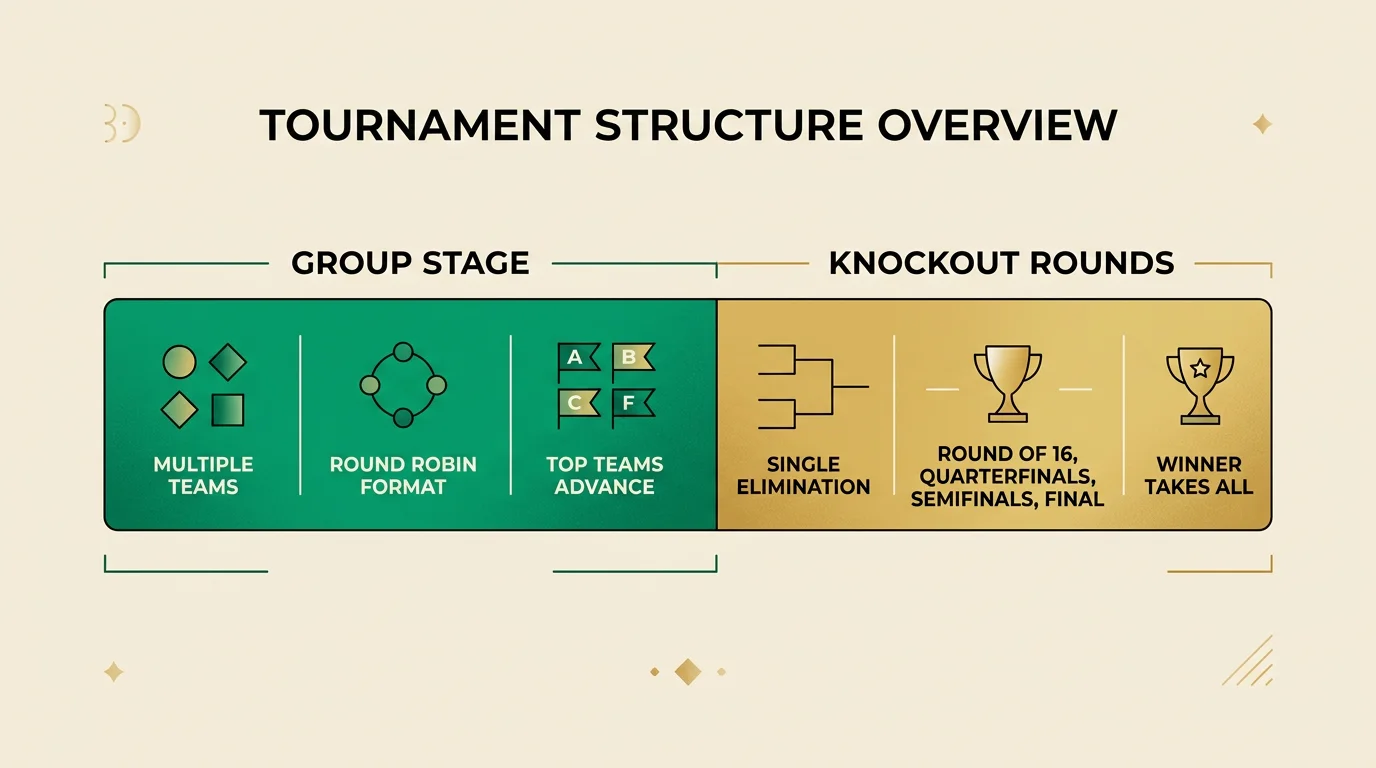
The tournament runs from 11 June to 19 July 2026. Twelve groups of four teams replace the familiar eight-group structure. Each group still plays the standard round-robin format, meaning every team faces every other team once, producing three matchdays and six matches per group. The critical difference lies in qualification: the top two teams from each group advance automatically, and then the eight best third-placed teams also progress to create a 32-team knockout bracket.
This third-place pathway fundamentally changes group stage dynamics. In previous tournaments, finishing third meant elimination. Now, a team can lose two group matches and still reach the Round of 32 if their goal difference and points compare favourably to third-placed finishers in other groups. For betting purposes, this creates several important shifts in how we should think about group stage markets.
First, the “dead rubber” phenomenon becomes more pronounced. When a team has already secured qualification with one group match remaining, the incentive to rest players increases because even a heavy defeat might not affect their seeding dramatically. Match betting on final group games requires careful analysis of what each team is actually playing for, not just their position in the table.
Second, goal difference matters more than ever. Two teams on three points in third place will be separated by goal difference when comparing across groups. This changes how teams approach matches where they are trailing — a 1-0 loss is significantly better than a 3-0 loss for third-place hopes, meaning we should expect more defensive adjustments when teams fall behind rather than the all-out attack we might see in a straight elimination format.
Third, the knockout bracket structure favours certain group positions over others. The Round of 32 draw is predetermined based on finishing position, so winning your group does not just mean easier opposition — it potentially means a more favourable path through the entire tournament. This should influence outright and tournament progress betting where you identify teams with a clear route to the latter stages.
The host nation dynamic adds another layer of complexity. The United States hosts 11 of the 16 venues and 78 of the 104 matches, with Mexico hosting 13 matches including the opening game at Estadio Azteca, and Canada hosting 13 matches across Toronto and Vancouver. The USA, Mexico, and Canada are all in separate groups and guaranteed home-soil matches throughout the group stage, though the bracket could see them playing in different countries during the knockouts.
For Irish punters, the timezone implications are significant. Most group stage matches kick off between 6pm and 2am Irish Standard Time (IST), with knockout rounds potentially running even later. This creates a natural in-play betting environment for those comfortable staying up late, while pre-match betting requires odds to be locked in well before the actual kick-off given the time difference.
World Cup Betting Markets: A Complete Reference
A punter walked into my local about three years ago, absolutely convinced he had found value on Germany to win the Euros because the odds seemed “too long.” He had never placed a tournament bet before, only ever backed Premier League accumulators. What he did not understand was the structural difference between league betting — where you are pricing relative strength over 38 matches — and tournament betting, where you are pricing the probability of winning a specific sequence of knockout matches against opponents you might not even know yet. The markets work differently, and understanding that difference is where profitable betting begins.
Outright and Futures Markets
The outright winner market is the flagship World Cup betting market, and it operates on what is essentially a probability distribution across all 48 teams. When a bookmaker prices Argentina at 9/2, they are implying roughly an 18% probability of Argentina winning the tournament (accounting for overround). The critical insight is that these prices reflect not just quality but the path to the final — a superior team in a difficult bracket may be worse value than a slightly inferior team with a clear run.
Each-way betting on outrights deserves special attention for this tournament. Most Irish bookmakers offer place terms of 1/4 odds for the first four (semi-finalists), though terms vary and checking before placing is essential. For a team priced at 25/1, an each-way bet at standard terms would return 25/4 (6.25/1) if they reach the semi-finals without winning the whole tournament. This dramatically changes the value equation for teams capable of a deep run but unlikely to lift the trophy.
Tournament specials include markets on highest-finishing team from each confederation, group winner doubles, and team to reach specific rounds. These derivative markets often carry more value than headline outrights because they attract less liquidity and therefore less bookmaker scrutiny. I have found consistent edges over the years by focusing on “to reach quarter-finals” markets for well-drawn teams where the bookmakers have essentially just divided the outright price rather than properly modelling the actual path.
Match Betting and Result Markets
The match result market — home, draw, away, or in World Cup terms, Team A, draw, Team B — forms the foundation of match-by-match betting. Tournament football produces draws at a higher rate than most domestic leagues because the stakes discourage risk-taking, particularly in group stages. The 2022 World Cup saw draws in approximately 25% of matches, compared to around 20% in the Premier League. Pricing draws appropriately is often where value lies.
Both teams to score and over/under goals markets translate directly from domestic football but require tournament-specific adjustment. Group stage matches typically see lower scoring than knockout matches, and the opening match of a group tends to be more conservative than the final matchday. Managers prioritise not losing the first match over chasing an early win, which suppresses goal expectation.
Correct score betting offers substantial potential returns but comes with appropriately higher risk. The key to this market is understanding that not all scorelines are equally likely even when they produce the same result. A 1-0 result is far more common than a 3-2 result in tournament football despite both being one-goal winning margins. Staking strategies for correct score should reflect this — smaller stakes on high-scoring lines, larger stakes on the most probable scorelines within your expected outcome.
Player Specials and Tournament Props
The Golden Boot market for tournament top scorer presents a fascinating betting puzzle. Historical data shows that top scorers often come from teams reaching at least the semi-finals (more matches equals more scoring opportunities) and frequently emerge from weaker groups where they can accumulate goals against inferior opposition. A striker from a dark-horse team in an easy group may offer better Golden Boot value than a star forward facing group-stage matches against quality defences.
Anytime goalscorer markets on individual matches require adjustment from domestic football because squad rotation is more common in tournament football. A manager might rest his first-choice striker in a third group match that is meaningless for qualification, dramatically reducing that player’s actual minutes on the pitch. Always confirm the expected lineup before backing an anytime scorer at short prices.
Booking markets — cards to be shown, player to be carded, and similar — often carry overlooked value in tournament football. Referees at World Cups historically show fewer cards per match than domestic referees, but the distribution shifts towards knockout matches where the stakes increase. Group stage card markets often offer value on the under side because referees are reluctant to issue yellow cards that might cause players to miss subsequent crucial matches.
How Fractional Odds Work: Reading and Calculating Returns
I still remember the confusion on a colleague’s face when I explained that 11/4 was a better price than 5/2 despite both looking roughly similar. For anyone raised on decimal odds from European betting exchanges, the fractional format that dominates Irish and British bookmakers requires a small mental adjustment — but once you have it, the advantages become clear.
A fractional odd expresses the profit you make relative to your stake. At 5/1, you make five units of profit for every one unit staked. If you bet ten euros at 5/1 and win, you receive fifty euros profit plus your ten euro stake returned, for a total payout of sixty euros. The first number is always the profit, the second number is always the stake required to generate that profit.
The half-point fractions trip up many punters. At 11/4, you make eleven units profit for every four units staked. A twenty euro bet at 11/4 returns twenty multiplied by eleven divided by four, which equals fifty-five euros profit, plus your twenty euro stake for a total return of seventy-five euros. This is a better price than 5/2 (which would return fifty euros profit on the same stake) even though 11/4 looks like a smaller number because the denominator is larger.
To convert fractional odds to implied probability, divide the right number by the sum of both numbers. At 4/1, the implied probability is 1 divided by (4+1), which equals 20%. At 11/4, it is 4 divided by 15, approximately 26.7%. This conversion matters because value betting is fundamentally about comparing your assessed probability to the implied probability — if you think a team has a 30% chance and the odds imply only 25%, you have found value even if the team ultimately loses.
For accumulators, fractional odds require conversion to decimal for easy multiplication. The formula is simple: divide the first number by the second and add one. So 5/1 becomes (5/1)+1 = 6.0, and 11/4 becomes (11/4)+1 = 3.75. Multiply the decimal equivalents together and convert back if needed: a double at 5/1 and 11/4 would be 6.0 multiplied by 3.75 equals 22.5, or 21.5/1 in fractional terms. Most bookmakers now show potential returns on the betslip, but understanding the mathematics helps identify when a displayed return looks incorrect.
The Irish and British tradition of fractional odds carries one genuine advantage: the standard prices create natural comparison points. Odds of 6/4, 13/8, 7/4, 15/8, and 2/1 represent small increments that help you quickly compare prices across bookmakers. Once you know that 6/4 is 2.50 in decimal and 7/4 is 2.75, you can mentally track which bookmaker is offering the best price without calculation. This speed advantage matters for in-play betting where prices shift rapidly. Clarify technical terms with our comprehensive World Cup 2026 betting glossary.
Staking Approaches for Tournament Football
The graveyard of World Cup betting is littered with punters who staked too heavily on opening-round matches and had nothing left for the knockout stages. I have seen it happen to sharps and mugs alike — the excitement of day one leads to outsized stakes, and by the quarter-finals, the bankroll is either gone or so diminished that profitable opportunities cannot be properly exploited. Tournament betting requires a staking plan calibrated to the full 39-day duration, not just the opening week.
Level staking — the same stake on every bet regardless of confidence — offers simplicity but wastes edge. If you have strong conviction on a match where you see substantial value, staking the same amount as on a marginal selection leaves money on the table. However, variable staking requires discipline that many recreational punters lack. The temptation to increase stakes after losses (chasing) or after wins (overconfidence) destroys even sound betting judgment.
Percentage-of-bankroll staking provides a middle ground. Determine your tournament bankroll — the amount you are prepared to lose across the entire World Cup — and stake 1-3% per bet depending on confidence level. A thousand euro bankroll means ten to thirty euro stakes, with the higher end reserved for your strongest selections. This approach naturally reduces stake size during losing runs (protecting the bankroll) and increases it during winning runs (maximising returns when judgment is proven sound).
For accumulator betting, the mathematics demand smaller stakes because the probability of winning decreases exponentially with each leg. A five-fold accumulator where each leg has a 50% probability of winning has only a 3.125% chance of success (0.5 to the power of 5). Staking as if this were a single bet is a recipe for bankroll destruction. I recommend treating accumulator stakes as entertainment spending rather than serious betting — small stakes for potentially large returns, but never money you need or expect to win back.
The tournament structure should influence stake allocation across time. Reserve at least 50% of your bankroll for the knockout stages, where match outcomes are more predictable and line value often greater. Group stage matches involve more uncertainty about team form, lineup choices, and motivation levels. By the quarter-finals, you know exactly who has travelled well, which managers are making sound substitutions, and which players have hit form — this information is worth more than pre-tournament analysis.
Betting in Ireland: Legal Context at a Glance
The Gambling Regulation Act 2024 transformed the Irish betting landscape just in time for this World Cup, and I have had more conversations about regulatory compliance in the past year than in the previous decade combined. For punters, the changes are largely protective rather than restrictive, but understanding the new framework helps you navigate the market and avoid operators who may not be fully compliant.
The Gambling Regulatory Authority of Ireland (GRAI) began accepting licence applications on 9 February 2026, with remote betting licences — covering online bookmakers — issued from 1 July 2026. This means the World Cup begins just ten days before the new licensing regime formally takes effect. Major operators have been preparing for years and will operate under transitional arrangements, but smaller or newer operators may face compliance challenges.
For punters, the practical implications centre on deposit methods and promotional restrictions. Credit cards are banned for betting transactions — only debit cards and bank transfers are permitted. Free bets, bonus credits, and VIP programmes face new restrictions designed to reduce inducements that encourage excessive gambling. If a bookmaker is still offering the kind of sign-up bonuses that were common two years ago, that is a red flag about their regulatory compliance.
The advertising watershed — no gambling advertising on television or radio between 5:30am and 9:00pm — means World Cup coverage will look different from previous tournaments. Digital advertising operates on an opt-in basis only. These restrictions do not affect your ability to bet, but they change how you might discover new bookmakers or offers. Established operators with existing customer relationships benefit from these changes at the expense of new market entrants.
For a comprehensive breakdown of what the new law means for your betting, including GRAI’s enforcement powers and punter protections, I have covered the full regulatory framework in the Irish betting law guide elsewhere on this site.
The Irish Bookmaker Landscape for World Cup 2026
Walking down any high street in Ireland, you will see more betting shops per capita than almost anywhere else in Europe. This cultural prevalence of betting translates to a competitive online market where Irish punters benefit from operators fighting for custom. The major players — Paddy Power, Boylesports, Betfair, and Ladbrokes among them — all offer World Cup coverage, but the quality of that coverage varies in ways that matter for serious punters.
Odds quality differs more than casual punters realise. On a standard Premier League match, you might see variation of 2-3% in implied probability between the best and worst prices offered. On World Cup outrights, that variation can reach 10% or more for less fancied teams. Shopping for the best price is not optional for value-conscious betting — it is essential. Having accounts with multiple operators allows you to always take the best available odds rather than accepting whatever your primary bookmaker offers.
In-play betting infrastructure varies significantly between operators. Some offer rapid markets with minimal delay, while others have noticeable lag between match events and price updates. For World Cup betting with time-zone challenges — matches kicking off late at night when attention may waver — the quality of the in-play interface matters more than usual. Test each operator’s platform before the tournament begins so you know where to direct your live betting action.
Each-way terms on tournament outrights represent a specific competitive dimension. The standard is 1/4 odds for the first four places (semi-finalists), but some operators offer enhanced terms during promotional periods, and others may only pay out on the first three. The difference between 1/4 odds for four places and 1/5 odds for three places is substantial for each-way value calculations — always verify terms before placing each-way selections.
Cash-out availability and terms also differentiate operators. The ability to take early profit (or cut losses) on accumulator bets and outright selections adds flexibility to tournament betting strategy. However, cash-out prices typically include a significant margin for the bookmaker, so the feature works best as insurance against unexpected developments rather than as a core strategy. Operators with competitive cash-out pricing add genuine value; those with poor cash-out terms essentially offer the feature in name only.
Common Pitfalls in World Cup Betting
Every tournament, I watch intelligent punters make the same predictable mistakes that could be avoided with a moment’s reflection. The excitement of a World Cup overwhelms normal betting discipline, and patterns that would never survive scrutiny during a league season suddenly seem reasonable when applied to knockout football. Let me walk through the traps I see most often so you can sidestep them.
The first and most common mistake is overvaluing pre-tournament form. A team that wins all their friendlies in May tells you very little about their actual World Cup chances because no competent manager reveals tactical intentions in warm-up matches. Brazil could win 5-0 against a weak opponent while resting three key players and experimenting with formations — that result should not significantly move your tournament assessment. Focus on squad quality, tournament experience, and historical performance rather than immediately pre-tournament results.
Second, punters consistently underestimate the impact of travel and climate. The 2022 World Cup in Qatar was played in air-conditioned stadia that neutralised weather advantages, but 2026 returns to outdoor summer football across a massive geographic spread. Teams playing in the high altitude of Mexico City face genuinely different conditions than those playing in the coastal humidity of Miami. European teams travelling to the West Coast face more severe jet lag than those playing in the Eastern time zone. These factors should inform your betting, particularly in the group stage when acclimatisation remains incomplete.
Third, the temptation to chase losses intensifies during a concentrated tournament. If your pre-tournament fancies crash out in the group stage, the impulse to recover by backing longer shots in subsequent matches can destroy a bankroll in days. The tournament runs for 39 days — there are always more betting opportunities tomorrow. Maintaining the discipline to step away after a bad run is harder during a World Cup than at any other time, precisely because the football does not stop.
Fourth, punters underrate the variance in Golden Boot and top scorer markets. The difference between finishing with four goals and finishing with five goals can be a single penalty kick in the semi-final. Harry Kane could be your top scorer selection, play magnificently throughout the tournament, and still lose the Golden Boot to someone who scores three goals against a weak group-stage opponent and then converts a late spot-kick in the final. Accept that these markets involve substantial luck and stake accordingly.
Fifth, and perhaps most insidiously, punters let national bias cloud their judgment. Irish punters who back England because of Premier League familiarity, or who oppose England because of historical rivalry, are both allowing emotion to override analysis. The most profitable approach is cold assessment of each team’s actual chances regardless of whether you want them to win or lose. Your heart can support whoever you like — your betting account should not know which team you are emotionally attached to.

Building Your World Cup Betting Framework
The punter who told me he had “won” the 2018 World Cup by backing France at 9/2 before the tournament missed a crucial point: one successful outcome does not validate a process. He could have been wrong in his analysis and still profited through variance. The goal of serious betting is not to win any single bet but to make decisions that would be profitable if repeated over many iterations. Building a proper framework means thinking about process rather than outcomes.
Start with a clear tournament thesis before the first ball is kicked. Which confederation looks strongest? Which teams have ideal draw paths? Where do the bookmakers appear to have mispriced based on public perception rather than underlying quality? This pre-tournament analysis forms the foundation of your betting — but it should be a foundation that remains flexible as new information emerges. A team that loses a key player to injury in the opening match should prompt reassessment, not stubborn adherence to pre-tournament views.
Record every bet with its reasoning. I have kept betting journals for over fifteen years, and reviewing past World Cup tournaments reveals patterns in my own thinking that would otherwise remain invisible. Did I systematically overrate South American teams? Did I chase losses after the group stage? Did I fail to adjust when specific managers made predictable substitution patterns? Your future self will thank you for the documentation.
Set loss limits and win targets before the tournament begins. If your bankroll drops by 50%, take a day off from betting. If your bankroll doubles, consider withdrawing your initial stake and playing with profits only. These circuit breakers prevent the emotional spiral that turns manageable losses into catastrophic ones. The World Cup will happen whether you are betting on it or not — protecting your bankroll for the knockout stages matters more than recovering early group-stage losses.
Finally, remember that entertainment value has monetary worth. If backing Ireland’s conquerors Czechia to crash out of Group A adds to your enjoyment of the tournament, the expected-value loss on that bet might be compensated by the entertainment gain. Professional bettors maximise edge; recreational bettors maximise enjoyment within a sustainable budget. Know which category you fall into and act accordingly.
What This Tournament Means for Irish Punters
The World Cup 2026 arrives at an inflection point for Irish betting culture. New regulations are reshaping operator behaviour, the tournament format is unprecedented, and the absence of Ireland from the finals after that agonising Prague penalty shootout creates a unique emotional context. We will be watching as neutrals with complicated feelings — rooting for Scotland as Celtic cousins, perhaps against Czechia as recent antagonists, and observing England with the ambivalence that comes from Premier League familiarity mixed with historical sporting rivalry.
This neutrality can be an advantage. Without an emotional stake in specific outcomes, Irish punters can approach the tournament with clearer analytical judgment than supporters whose teams are competing. Use that clarity. Back outcomes you assess as probable regardless of which team benefits. The bookmakers are pricing based on liquidity flows from passionate supporters — your detachment from those flows is an edge in itself.
The late-night schedule means this will be a different viewing experience than European tournaments. Building a sustainable approach to 2am kick-offs is part of tournament preparation. Plan for which nights you will stay up for live viewing and which you will watch on replay. Betting on matches you will not see live requires different timing — getting positions on before you sleep rather than reacting to live action. This is not inferior to in-play betting, just different. Learn how to bet on our homepage.
Most of all, approach the World Cup 2026 as the rare betting opportunity it represents. For six weeks, every football fan in the world focuses on the same matches at the same times. The liquidity is enormous, the markets are deep, and the opportunities for finding edge exist for those who have done the preparation. This guide provides the framework. The analysis and discipline are up to you.
What is the best market for beginners betting on World Cup 2026?
Match result betting on group stage fixtures offers the most straightforward entry point. You are assessing which of three outcomes — Team A win, draw, or Team B win — is most likely for a single match. Avoid accumulators initially because the variance is too high, and avoid outrights because the tournament is too long to properly evaluate at the outset. Start with individual matches, track your results, and expand from there.
How do I know if I am getting value on a World Cup bet?
Value exists when your assessed probability exceeds the implied probability of the odds offered. If you believe a team has a 30% chance of winning but the odds imply only a 25% chance, that is value. The challenge is accurate probability assessment. Compare your views to closing lines from betting exchanges — over time, if you are consistently finding prices that the market eventually moves toward, your assessments are sound.
Should I bet on every match at the World Cup?
No. Selectivity improves returns. Some matches offer clearer analytical edges than others — perhaps you have deeper knowledge of one team, or the market has mispriced based on recent form that you know to be misleading. Forcing bets on matches where you have no edge is entertainment spending, not investment. Quality over quantity applies to tournament betting more than any other context.
Are there any World Cup betting markets to avoid entirely?
Player booking markets carry high variance because referee tendencies differ and card rates in tournaments are historically lower than domestic football. First goalscorer markets combine the variance of goalscorer betting with the additional uncertainty of timing. Both can be profitable with sophisticated modelling but are difficult for recreational punters. Tournament top scorer markets involve substantial luck regardless of analytical quality. Proceed with caution on all three.
