
In-Play Betting at World Cup 2026
 Available in US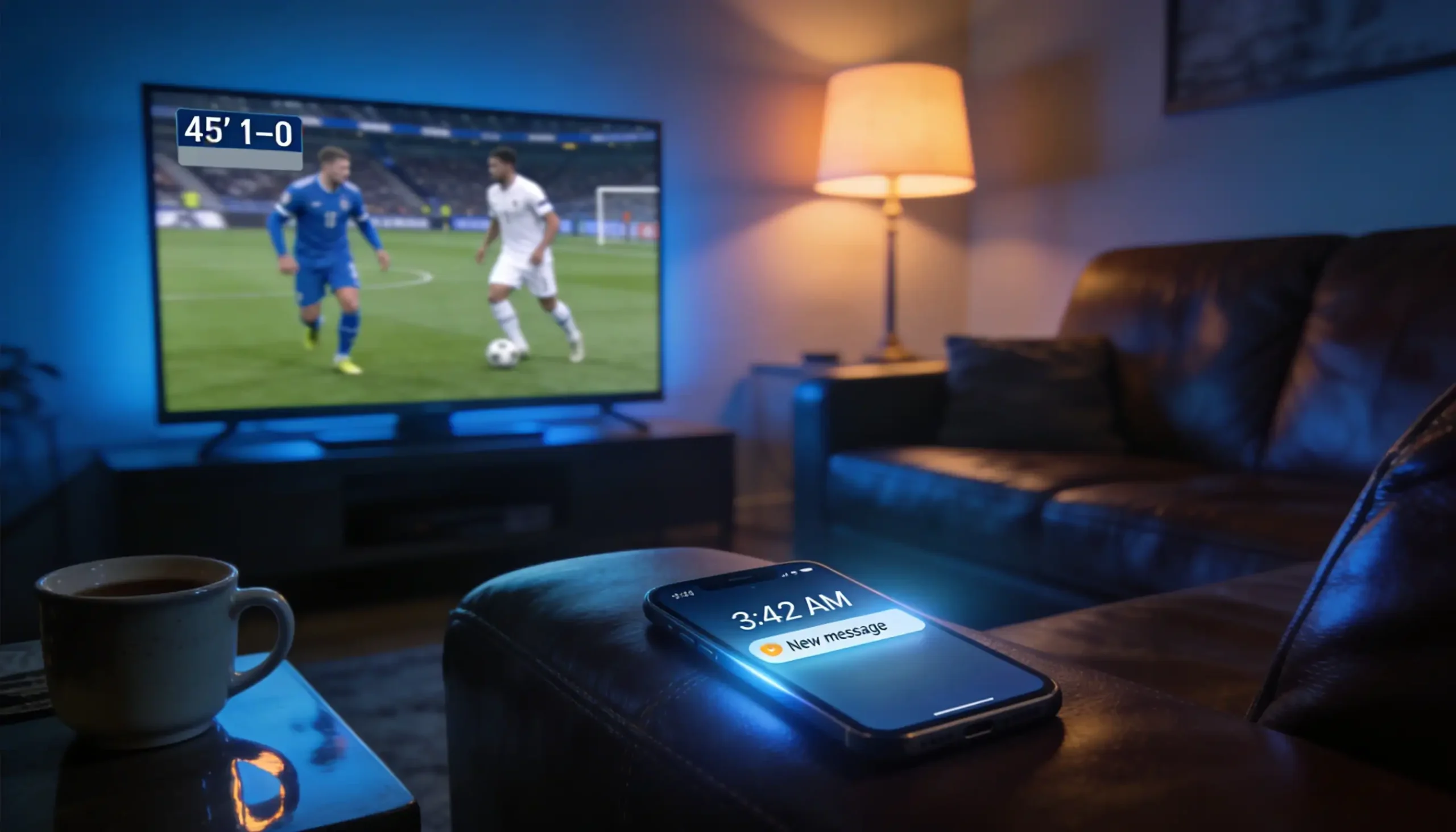
At 1:47am on 6 December 2022, I watched Richarlison score a bicycle kick against Serbia in a group match that had started at 7pm local time in Lusail but landed at midnight Irish time. My in-play bet on Brazil to score the next goal had been placed thirty seconds before the ball hit the net. That is the essence of live betting at a World Cup — split-second decisions at unreasonable hours, fuelled by caffeine and the conviction that you see something the algorithm does not. The 2026 World Cup will push this dynamic further than any previous tournament, with the majority of evening kick-offs in the United States landing between midnight and 3am IST. For Irish punters, in-play betting at this World Cup will be a test of discipline as much as a test of football knowledge.
The IST Factor: Late-Night Kick-Offs and Their Impact
How many matches will you realistically watch at 2am on a work night? That is the question every Irish punter should ask before the tournament begins, because the answer shapes your entire in-play strategy. The United States spans four time zones, and the 2026 World Cup schedule reflects that spread. East Coast venues like MetLife Stadium and Hard Rock Stadium are five hours behind IST during the summer. West Coast venues like SoFi Stadium in Los Angeles and Lumen Field in Seattle are eight hours behind.
A 9pm ET kick-off — a standard evening slot for American audiences — translates to 2am IST. A 10pm ET kick-off on the West Coast hits 3am in Dublin. Even the earlier evening fixtures at 6pm ET land at 11pm IST, well past the prime-time viewing window for anyone working the next morning. The group stage runs from 11 June to 28 June, with most matchdays featuring three or four fixtures. The first kick-off of the day will typically fall between 6pm and 8pm IST (afternoon slots in the US), which is manageable. But the headline matches — the ones involving the biggest teams and the most liquid in-play markets — will overwhelmingly occupy the late evening and night-time slots.
This has two practical consequences for in-play betting. First, you need to decide in advance which matches you will stay up for and which you will skip. Trying to watch and bet on every late-night fixture across a three-week group stage is a recipe for sleep deprivation and poor decision-making. I pick three or four matches per week that I consider genuine in-play opportunities and ignore the rest. Second, the fatigue factor is real and measurable. Research on cognitive performance consistently shows that decision-making quality declines after midnight, with significant impairment after 2am for anyone on a normal sleep schedule. If you are placing live bets at 2:30am, your judgement is not what it was at 8pm.
My approach for the 2026 World Cup: identify the fixtures with the strongest in-play potential (mismatches likely to produce second-half goals, knockout matches between evenly matched sides), plan to watch those matches live, and place all non-live bets before 10pm IST. The late-night session is for watching and selective live betting only — not for building accumulators or making outright market moves.
Available In-Play Markets for World Cup Matches
Walk into a Paddy Power or BoyleSports shop at 2pm on a Saturday and the in-play screen shows maybe twenty markets for a Premier League match. Open the same bookmaker’s app during a World Cup knockout match and you will find fifty or more. The scale of live markets at a World Cup reflects the global audience and betting volume: bookmakers invest heavily in live pricing for the tournament because it is their highest-turnover period outside of domestic football seasons.
The core in-play markets mirror their pre-match equivalents but with dynamic odds that shift with every significant event on the pitch. Match result odds update after goals, red cards, and significant tactical changes. Next-goal markets are offered continuously throughout the match, settling and reopening with each goal. Total goals lines (over/under) adjust as goals are scored — a match that is 2-1 at half-time will have its over/under line reset, typically at 3.5 or 4.5 for the full match.
Beyond the standard markets, in-play betting at a World Cup includes time-specific propositions: a goal to be scored between the 60th and 75th minute, the next corner to occur in the next five minutes, or a booking before the 30th minute. These micro-markets are priced based on live match data — expected goals, possession patterns, fouls committed — and they update rapidly. The key to these markets is speed: the odds shift within seconds of a significant event, and the window to place a bet at advantageous odds is narrow.
In-play player markets are increasingly sophisticated. Anytime goalscorer odds adjust based on minutes remaining, the player’s involvement in the match, and the match state. A striker who has had three shots on target by the 60th minute but has not scored will be priced shorter for an anytime goal than a substitute who has just entered the pitch. Some operators also offer live assist markets, shots-on-target totals, and player passing statistics — markets that were unavailable even at the 2022 World Cup.
Cash-out is the most significant in-play tool available to punters. If you placed a pre-match bet on a team to win and they are leading 1-0 at 70 minutes, the cash-out offer represents the bookmaker’s assessment of the remaining probability that your bet wins. A EUR 10 bet at 5/2 to win EUR 25 profit might show a cash-out offer of EUR 20 when the team leads with twenty minutes remaining. Accepting locks in a EUR 10 profit. Declining keeps the full EUR 25 profit in play but risks the team conceding an equaliser. The decision is yours, and it should be based on your assessment of the remaining risk — not on whether you feel lucky. Understand different markets by checking all World Cup betting types.
In-Play Strategies for Tournament Football
The most reliable in-play strategy I have used across three World Cup cycles is backing a strong favourite to win the second half after a goalless first period. Tournament football produces goalless first halves at a higher rate than domestic leagues — tactical caution, unfamiliar opponents, and the high stakes of a World Cup all contribute to cagey opening 45 minutes. When a clear favourite is held 0-0 at half-time, the market overreacts. The odds on the favourite to win the match drift from pre-match prices of, say, 1/3 to in-play prices of 4/6 or 3/4. The underlying quality gap has not changed — only the scoreline has.
Backing the favourite to win the second half (a separate market from the full-time result) at enhanced odds of around 5/6 to evens after a goalless first half captures the probability correction that typically follows. The stronger team adjusts tactically, the weaker team tires physically, and goals arrive. This is not a guaranteed strategy — some 0-0 first halves remain 0-0 at full-time — but the expected value over a series of these bets across a tournament is positive, particularly in group-stage mismatches.
A second strategy focuses on knockout matches headed for extra time. When a knockout tie is level at 75 minutes or later, the draw price for 90-minute settlement shortens rapidly as the market recognises that neither team is likely to score a winner in the final fifteen minutes. Meanwhile, the “to qualify” market — which includes extra time and penalties — continues to reflect the underlying quality gap. If a strong team is level with a weaker opponent at 80 minutes, the “to qualify” price might be 2/7 while the 90-minute draw price is 4/5. Backing the draw at 4/5 and the stronger team to qualify at 2/7 in separate bets creates a position where you profit from the draw (the most likely outcome in the remaining ten minutes) and have a hedge via the qualification market. This is not arbitrage — the combined stake exceeds the guaranteed profit — but it creates a favourable risk-reward profile for the final phase of tight knockout matches.
A third strategy is simply to bet against teams that have conceded a red card. A sending-off in a World Cup match transforms the dynamics completely: the ten-man side drops deeper, the game opens up, and goals tend to follow. Backing the team with numerical advantage to score the next goal at whatever price is offered immediately after a red card is a consistent value play. The market adjusts quickly, so speed matters — place the bet within sixty seconds of the card being shown, before the odds fully reflect the new situation.
Staying Disciplined During Live Betting Sessions
The biggest risk of in-play betting is not a losing selection — it is losing control of your staking. Live betting at a World Cup is designed to be immersive: the matches are dramatic, the odds update constantly, and the platform nudges you toward the next bet before you have processed the last one. At 2am, with adrenaline overriding fatigue, the temptation to chase a losing bet or increase stakes after a win is acute.
I use three rules to manage in-play discipline during tournaments. First, a session bankroll. Before any late-night viewing session, I decide the maximum amount I will stake across all in-play bets that evening. Typically EUR 20 to EUR 30 for a session covering two or three matches. When the session bankroll is gone, I stop betting and continue watching. This removes the decision-making pressure of whether to place another bet — the budget decides, not my emotions.
Second, a cooling-off period. After any losing bet, I wait at least ten minutes before placing another. This prevents the immediate chase response — the urge to “win it back” with a hasty follow-up bet at worse odds. Ten minutes is long enough for the emotional spike to subside and short enough that the match is still in progress if a genuine opportunity arises.
Third, no in-play bets after the 85th minute. Late goals at World Cups are dramatic, memorable, and almost impossible to predict. The five minutes between 85 and 90 (plus stoppage time) are the highest-variance period of any match, and the in-play odds reflect that uncertainty with wide margins. Placing bets in this window is speculation, not strategy. I close my app’s betting function at 85 minutes and watch the remainder as a fan, not a punter.
The complete World Cup 2026 betting guide covers bankroll management in broader terms. For in-play specifically, the message is: set limits before the session begins, stick to them when the adrenaline flows, and accept that some of the best in-play opportunities are the ones you let pass because the timing or the price was not quite right. Find live odds on our homepage.
Making the Late Nights Count
In-play betting at the 2026 World Cup will test every Irish punter who stays up past midnight. The matches will be extraordinary — this is the biggest football tournament ever staged, across three countries and sixteen stadiums, with 48 nations competing over 39 days. The temptation to bet on every twist and turn will be relentless. The punters who profit from in-play will be the ones who watched selectively, bet sparingly, and treated the late-night sessions as a curated experience rather than an all-night buffet. Pick your matches. Set your limits. And when the alarm goes off at 7am after a 3am finish, make sure the only thing you lost was sleep.
What time will World Cup 2026 matches kick off in Ireland?
Most matches will kick off between 6pm and 3am IST. Afternoon fixtures in the US (12pm-2pm ET) translate to 5pm-7pm IST. Evening fixtures (6pm-9pm ET) land at 11pm-2am IST. Late West Coast kick-offs could start as late as 3am IST. The exact schedule depends on the venue, with East Coast matches earlier than West Coast fixtures.
Is in-play betting riskier than pre-match betting?
In-play betting carries higher variance because decisions are made under time pressure with incomplete information. The odds shift rapidly, and emotional reactions to live events can override rational assessment. However, in-play also offers opportunities that pre-match betting cannot — the ability to react to tactical changes, injuries, and match flow in real time. The risk depends on the punter"s discipline and preparation, not the market itself.
